
Supreme Court
S. 31(7) Arbitration | Arbitral Tribunal Has Power To Award Different Rates Of Interest For Pre-Reference & Pendente Lite Period : Supreme Court
The Supreme Court held that under the Arbitration and Conciliation Act, 1996, an Arbitral Tribunal has the power to award different rates of interest for different phases.A bench comprising Justices Abhay S. Oka and Ujjal Bhuyan overturned the Delhi High Court's ruling, which had invalidated the tribunal's grant of interest on interest, deeming it impermissible under Section 31(7) of the Act. The bench heard the case where the dispute originated from a 1984 contract for the Thermal Power...
Supreme Court Deprecates 'Deliberate, Ambiguous' Drafting Of Arbitration Clauses; Calls For Suo Motu Action In Malafide Cases
Delivering a significant judgment on arbitration law, the Supreme Court today deprecated the practice of arbitration clauses being deliberately phrased "ambiguously" by members of legal fraternity and urged judicial forums across the country to throw out cases involving "shoddily drafted arbitration clauses" at the threshold.The Court said that such "malafide cases" are a "criminal wastage of judicial time" and have been allowed to go on for long. It called on the judicial forums to take...

Private Arbitration Clauses Cannot Override Statutory Mandates Under MSMED Act : Supreme Court
Reaffirming that the MSMED Act prevails over the Arbitration Act, as held in Gujarat State Civil Supplies v. Mahakali Foods, the Supreme Court set aside the Karnataka High Court's interference with MSMED proceedings in Delhi, despite the contract naming Bengaluru as the arbitration seat. The Court clarified that private contractual clauses cannot override the statutory mandate of the MSMED Act. Since the appellant-supplier was registered in Delhi, the Court noted that the Delhi Arbitration...

High Court May Grant Article 227 Interim Relief In Arbitration Proceedings In Exceptional Cases : Supreme Court
aThe Supreme Court (May 7) held that while the Arbitration and Conciliation Act, 1996 (“Arbitration Act”) mandates minimal judicial interference, a High Court may, in exceptional cases, exercise its supervisory jurisdiction under Article 227 of the Constitution to grant interim relief, particularly where denial of such protection would result in irreparable harm. “We are aware of the established legal principle that the Courts should refrain from interfering with the invocation of a bank...
Dispute Over Full & Final Settlement Is Arbitrable Despite Parties Discharging Contract : Supreme Court
The Supreme Court today (May 6) observed that if the insured alleges coercion in arriving at a settlement with the insurer, then the dispute over the validity of the settlement remains arbitrable. “Any dispute pertaining to the full and final settlement itself by necessary implication being a dispute arising out of or in relation to or under the substantive contract would not be precluded from reference to arbitration as the arbitration agreement contained in the original contract continues to...

Can Arbitral Awards Be Modified In Setting-Aside Proceedings? – A Brief On Supreme Court's Re-Interpretation Of Section 34 Of Arbitration Act
Section 34 of the Arbitration and Conciliation Act, 1996 ('Act'), governs the setting-aside of awards arising from arbitrations seated in India. This provision does not provide any powers for the setting-aside court to vary or modify portions of the award. This was the legal position in vogue under Indian law, until the Hon'ble Supreme Court's reinterpretation of Section 34, by its judgment dated 30th April 2025 in Gayatri Balasamy v. M/s ISG Novasoft Technologies Limited ('Balasamy'). By their...
If Courts Can Only Set Aside Awards & Can't Modify Them, Parties Will Be Forced To Undergo Fresh Round Of Arbitration : Supreme Court
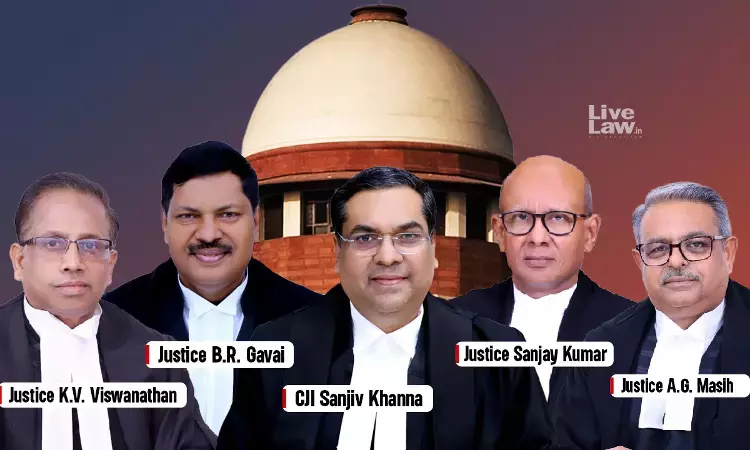
The Supreme Court recently held that in order to ensure efficient dispute resolution and uphold the objectives of the Arbitration and Conciliation Act 1996, the Court should be allowed to modify awards when parties challenge the tribunal's decision. The decision was rendered by a Constitutional Bench led by CJI Sanjiv Khanna comprising Justices BR Gavai,Sanjay Kumar, AG Masih and KV Viswanathan. Justice KV Viswanathan, however dissented on th issue whether Courts can modifiy awards under...
Supreme Court Criticises Arbitration Bill 2024 For Not Recognising Power To Implead Non-Signatories, Urges Union To Make Changes
The Supreme Court today (May 2) expressed its dissatisfaction with the continued absence of explicit statutory recognition for the power of arbitral tribunals to implead or join non-signatory parties. The Court noted with concern that, despite earlier omissions in the Arbitration and Conciliation Act, 1996, the newly proposed Arbitration and Conciliation Bill, 2024, which seeks to overhaul the legislation, also failed to address this critical issue.“The Department of Legal Affairs has now, once...

When Can Court Remand Arbitral Award To Tribunal Under S.34/37 Arbitration Act ? Supreme Court Explains
The Supreme Court Constitution Bench recently held that the powers of Courts to remand arbitral awards back to the Tribunal under S. 34(4) of the Arbitration and Conciliation Act 1996 cannot be seen as a straight-jacket formula. The Court observed that an award should be remitted back only if there is a possibility to correct a defect in the award, but if the entire award suffers from substantial injustice and patent illegality, remittance should be avoided. The Constitution...
Courts Can Modify Arbitral Awards In Certain Circumstances Under S.34/37 Arbitration Act: Supreme Court By 4:1
Answering a reference, a Constitution Bench (by 4:1) of the Supreme Court held that Appellate Courts have limited powers to modify arbitral awards while exercising powers under either Section 34 or 37 of the Arbitration and Conciliation Act, 1996.The majority judgment by Chief Justice of India Sanjiv Khanna held that the Courts have a limited power under Section 34/37 to modify arbitral awards. This limited power can be exercised in the following circumstances :1. When the award is severable by...
S.34 Arbitration Act | Respect Arbitral Autonomy; Judicial Interference Should Be Minimal : Supreme Court
The Supreme Court reiterated that the courts cannot go beyond the scope of Section 34 of the Arbitration & Conciliation Act, 1996 (“Arbitration Act”) while deciding an application for setting aside of an award."the role of the court under Section 34 of the 1996 Act is clearly demarcated. It is a restrictive jurisdiction and has to be invoked in a conservative manner. The reason is that arbitral autonomy must be respected and judicial interference should remain minimal otherwise it will...

Arbitral Award For Claims Not Included In IBC Resolution Plan Can't Be Enforced: Supreme Court
The Supreme Court recently allowed an appeal challenging the enforcement of an arbitral award passed by the Micro and Small Enterprises Facilitation Council (MSEFC) against Electrosteel Steels Ltd., holding that the award was non-executable in view of the resolution plan approved under Section 31 of the Insolvency and Bankruptcy Code (IBC), 2016.“we have no hesitation to hold that upon approval of the resolution plan by the NCLT, the claim of the respondent being outside the purview of the...