
COMPANY LAW
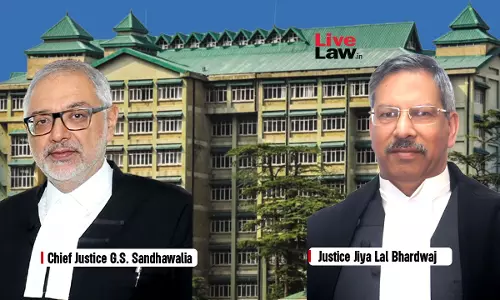
State & Union Failed To Enforce CSR Obligations After 2025 Rainfall Disaster: Himachal Pradesh High Court
The Himachal Pradesh High Court, while taking suo motu cognisance of the devastation caused by the excess rainfall in 2025, held that both the State Government and the Union of India failed to effectively enforce Corporate Social Responsibility obligations under the Companies Act, 2013. The Court noted that despite a clear statutory framework, no steps were taken to utilise the CSR funds for disaster relief and rehabilitation of infrastructure. Division Bench of Chief Justice G.S....

Name Clashes: Resolving Conflicts Between Corporate Identities And Trademarks
With the competitive corporate environment in India, disputes over identical or similar names have become increasingly common, as trademarks and company names frequently overlap. Confusion and disputes over ownership and resemblance with existing entities and goodwill have often seen the emergence of fresh startups pitted against long-standing businesses. This article looks at the development of Indian law over such disputes from the shift from Section 22 of the Companies Act, 1956, to Section...

Banks Cannot Penalise Borrowers For Switching Lenders, Prepaying Loans: Orissa High Court
The Orissa High Court recently held that banks cannot impose charges that restrict a borrower's freedom to switch lenders, ruling that such practices undermine fair banking standards and violate binding directions of the Reserve Bank of India. A bench of Justice Sanjeeb K Panigrahi said banks must operate within regulatory limits set by the RBI and cannot create barriers that penalize...
Supreme Court To Examine If NCLAT Can Refer Matter To Third Member When Two-Member Bench Delivers Split Verdict
The Supreme Court is set to decide whether, in the case of a split verdict by the National Company Law Appellate Tribunal (“NCLAT”), the reference of the case to a third member would be legally justifiable or should the matter be referred to a larger bench of three members for fresh adjudication. Observing that there is no clear procedure to address situations where a two-member bench...

Change In Form Or Rephrasing Of Relief Cannot Defeat Principle Of Constructive Res Judicata: Kerala High Court
The Kerala High Court has recently clarified that changing the form or rephrasing of a relief prayed for cannot defeat the principles of res judicata and constructive res judicata.Justice Mohammed Nias C.P. was considering a writ petition filed by a registered MSME (Micro, Small and Media Enterprise) that had sought protection under the Central Government notification, which mandates banks...
Change In Form Or Rephrasing Of Relief Cannot Defeat Principle Of Constructive Res Judicata: Kerala High Court
The Kerala High Court has recently clarified that changing the form or rephrasing of a relief prayed for cannot defeat the principles of res judicata and constructive res judicata.Justice Mohammed Nias C.P. was considering a writ petition filed by a registered MSME (Micro, Small and Media Enterprise) that had sought protection under the Central Government notification, which mandates banks...

Non-Resident Company Need Not Have Permanent Office In India To Be Taxed On Income Accruing Here : Supreme Court
The Supreme Court has clarified that under the Income Tax Act, a non-resident company can be taxed in India on income that accrues or arises from a business connection within the country, even if it does not maintain a permanent office or physical establishment here.A Bench of Justice Manoj Misra and Justice Joymalya Bagchi, in its judgment examined the scope of Sections 4, 5(2), and 9(1)(i)...
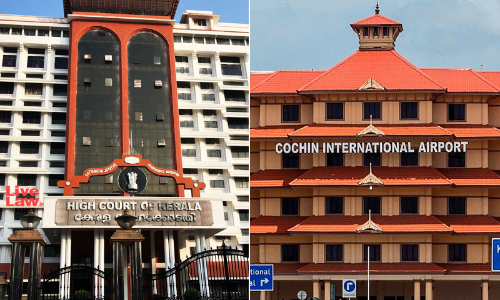
Kerala High Court Dismisses Plea Against CIAL's Decision To Conduct Online AGM, Says Centre Can Exempt Physical Meeting U/S 96 Companies Act
The Kerala High Court recently dismissed a plea challenging the decision of the Cochin International Airport Ltd. (CIAL) to conduct its Annual General Body Meeting (AGM) through online modes.Rejecting the petitioner's contention that the AGM has to be held either at the registered office of the Company or some other place within the city, town or village, Justice N. Nagaresh dismissed the...

SFIO Probe Against Company Citing Public Interest 'Extremely Serious Action', Due Application Of Mind Must: Delhi High Court
The Delhi High Court has observed that Serious Fraud Investigation Office (SFIO) investigation against a company citing public interest is an extremely serious statutory action and an order to that effect must reflect due application of mind. “An order under Section 212(1)(c) of the Act, 2013 directing investigation by the SFIO is not a routine administrative measure. It is in the nature of...

Defaulting Director Can Be Disqualified From All Companies, S.164 Is Reasonable Restriction To Article 19(1)(g): Karnataka High Court
The Karnataka High Court has held that under Section 164 of the Companies Act 2013, an individual can be disqualified from being a Director in a company against which allegations are made, as well as regarding any other company in which the individual is a director against whom no allegations are made.The petitioner directors had argued that they had been disqualified from the...

Of Profits And People: A Legal Odyssey Between Shareholder Supremacy And Stakeholderism
Professor Joe Badaracco in the documentary titled 'The Corporation' puts forward the idea that a Corporation is composed of a group of individuals who work for a bouquet of goals, the leading one of which is to earn huge sustainable and lawful return for the proprietors. The Civil War coupled with the Industrial Revolution changed the magnitude at which these corporations operated. The Corporations grew more power hungry, and they wanted to free themselves from the constraints which were imposed...

Selective Allotment And New Rights Issue Framework: A Double-Edged Reform
The Securities and Exchange Board of India (SEBI), on 4th March, 2025, introduced the SEBI (Issue of Capital and Disclosure Requirements) (Amendment) Regulations, 2025, which also added a new framework for rights issue. In due course, on March 11, 2025, SEBI issued a circular setting out the timelines for completing various activities involved in rights issues and permitting selective allotment to specific Investors.This article compares the changes made in the rights issue process with the...