
Calcutta High Court
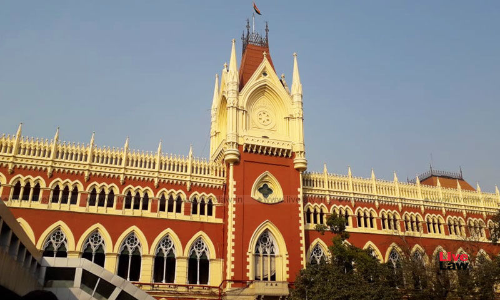
Counterclaim In Arbitration Cannot Be Allowed After Commencement Of Claimant's Evidence: Calcutta High Court
The Calcutta High Court bench of Justice Hiranmay Bhattacharyya has held that a counterclaim in arbitration proceedings cannot be allowed after the commencement of the claimant's evidence, as doing so would cause serious injustice to the other party. The present petition has been filed under Article 227 of the Indian Constitution against an order passed by Arbitrator by which an application seeking amendment in the Statement of Defence (SoD) to include a counterclaim was rejected. ...
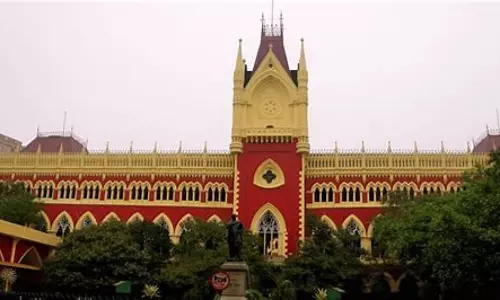
State Gains Revenue Only If Businesses Operate; Cancelling GST Registration On Procedural Grounds Serve No Purpose: Calcutta High Court
The Calcutta High Court stated that the state gains revenue only if business operates; GST registration cancellation on procedural grounds serves no purpose. Justice Aniruddha Roy stated that the cancellation of GST registration of the assessee on the procedural ground would not enure any benefit either to the revenue authority or to the assessee. On the contrary, if the GST certificate stands restored and the assessee is allowed to carry on its business, the State can earn revenue to...
Delivery Of Certified Copy Of Award After Signing & Authentication Constitutes Valid Service U/S 31(5) Of Arbitration Act: Calcutta HC
The Calcutta High Court bench of Justice Shampa Sarkar held that delivery of a certified copy of the award, signed by the members, when properly addressed, stamped, and sent by speed post with delivery confirmed by the postal department, amounts to effective service even if the original signed copy of the award is not dispatched. The present application has been filed under section 47 of the Civil Procedure Code (CPC) seeking a declaration that the award dated 10.11.2020 is non-est and...
Proceedings Between Expiry Of Arbitrator's Mandate And Its Extension Are Not Void If Mandate Is Extended: Calcutta High Court
The Calcutta High Court bench of Justice Shampa Sarkar held that proceedings conducted by the Arbitrator between the expiry of the mandate and its subsequent extension cannot be declared void once the application seeking extension is allowed. Upon extension, the mandate relates back to the date of expiry. The present application has been filed seeking extension of the Arbitrator's mandate. Earlier, the Respondent objected on the ground that the Arbitration continued the proceedings...
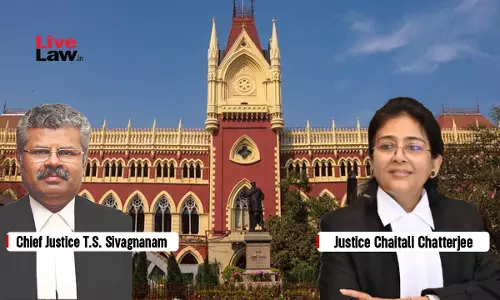
Income Tax | Interest Earned On Surplus Lending Funds Is Attributable To Banking Business, Qualifies For 80P Deduction: Calcutta High Court
The Calcutta High Court stated that interest earned on surplus lending funds is attributable to banking business, qualifies for 80P deduction under Income Tax Act. Section 80P of the Income Tax Act, 1961 provides 100% tax deductions to cooperative societies for income from specified activities. These activities commonly include marketing agricultural produce, purchasing agricultural supplies, processing products without power, offering banking services, and more. Chief Justice T.S....
Writ Petition Not Maintainable Against Officer's ITC Finding Made Within Jurisdiction: Calcutta High Court
The Calcutta High Court stated that writ not maintainable against officer's ITC finding made within jurisdiction. Justice Raja Basu Chowdhury stated that “Though, violation of principles of natural justice, and a challenge on jurisdictional issue can be maintained, such issue must, relate to an exercise of jurisdiction by an authority which it does not have, and not merely an error committed within its jurisdiction.” In this case, on the basis of audit observation under Section 65...
Reference To Dispute Resolution Board Not Mandatory Before Invoking S.11(6) Of Arbitration Act If It Is Not Constituted On Time: Calcutta HC
The Calcutta High Court bench of Justice Shampa Sarkar has held that a party cannot be compelled to approach the Dispute Resolution Board (DSB) for resolution of disputes first before invoking the jurisdiction of the court under section 11(6) of the Arbitration Act especially when the DSB was not constituted as per terms of the contract and its composition was not even communicated to the Petitioner within the stipulated time period after the execution of the contract therefore seeking...

Cause Of Action Arises From Clear Refusal To Perform Contractual Obligations, Not Mere Non-Performance: Calcutta High Court
The Calcutta High Court bench of Justice Shampa Sarkar held that when there is a clear refusal by one of the parties to perform the terms of a contract, the cause of action arises from the date of such refusal, and not from the date of initial non-performance, especially where negotiations continued, implying that the parties possibly wanted to extend the time for performance. The present application filed under section 11(6) of the Arbitration and Conciliation Act, 1996 arose from an ...
Rejection Of Claims By Writ Court Over Disputed Issues Does Not Bar Reference To Arbitration: Calcutta High Court
The Calcutta High Court bench of Justice Shampa Sarkar has held that when the claims of the petitioner are not adjudicated by writ courts and subsequently by the Supreme Court in a Special Leave Petition on the ground that they involve disputed questions of fact and law which are beyond the remit of the court, and the petitioner is directed to invoke the alternative remedy of arbitration due to the undisputed existence of an arbitration clause, the matter should be referred to arbitration...
Mere Use Of Expression “Arbitration” Insufficient To Constitute A Binding Agreement U/S 7 Of A&C Act: Calcutta High Court
The Calcutta High Court bench of Justice Shampa Sarkar has held that mere use of the expression “Arbitration” in a clause will not automatically make the clause a binding arbitration agreement as contemplated under Section 7 of the Arbitration Conciliation Act, 1996 unless there is a clear intent to refer disputes to Arbitration. The court observed that an arbitration agreement has to be couched not in precatory, but obligatory words. Although, there is no particular form or universally ...
Stock Exchange & Banking Channels Cannot Mask Sham Transactions Carried Out Through Bogus Capital Loss Claim Companies: Calcutta High Court
The Calcutta High Court held that stock exchange and banking channels cannot mask sham transactions carried out through bogus capital loss claim companies. Justices T.S. Sivagnanam and Chaitali Chatterjee (Das) observed that “the entire information contained in the investigation report was apprised to the assessee by the assessing officer and thereafter the show cause notices was issued for which the assessee' submitted their reply and in the reply they did not raise any issue that...
Mere Incorporation Of Investing Companies Under Companies Act Not Enough To Prove Genuineness Of Share Transactions: Calcutta High Court
The Calcutta High Court held that mere incorporation of investing companies under the Companies Act is not enough to prove the genuineness of share transactions. The bench opined that, admittedly, the shares were by way of a private placement. Though the investing companies might have been incorporated under the provisions of the Company's Act, that by itself will not validate the transaction. Justices T.S. Sivagnanam and Chaitali Chatterjee (Das) stated that “though it can be...