
Kerala High Court

Assessments U/S 17D Kerala General Sales Tax Act Must Be Finalised Within Reasonable Time Despite Absence Of Limitation Period: High Court
The Kerala High Court stated that the assessments under Section 17D Kerala General Sales Tax Act must be finalised within a reasonable period despite the absence of a limitation period. Justices A. Muhamed Mustaque and Harisankar V. Menon stated that even when the statute does not provide for an outer time limit, the authority has to exercise jurisdiction within a reasonable time. The reasonable period of time for such assessment has to be fixed with reference to the other provisions...
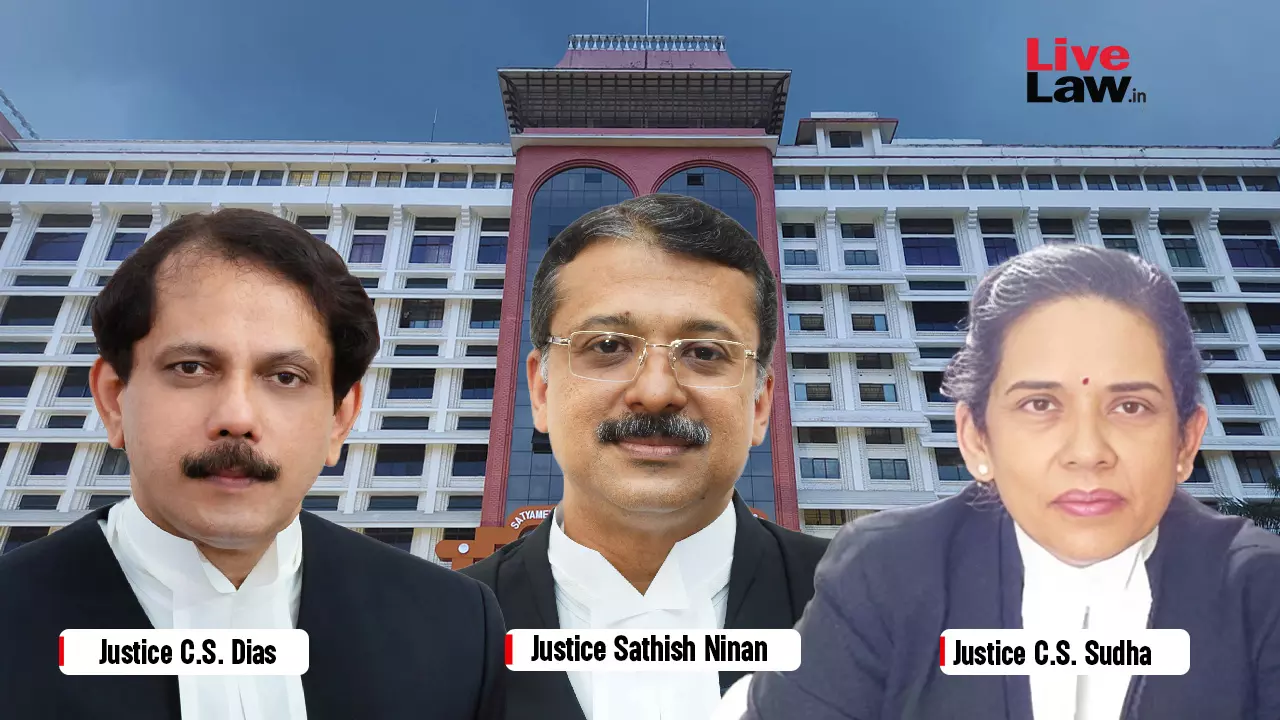
Market Value Of Property Must Be Determining Factor Under Commercial Courts Act, Not Court Fee Value: Kerala High Court
The Kerala High Court has held that the market value of the property must be the determining factor under Section 12 (1)(c) of the Commercial Courts Act, and not the valuation adopted for the purpose of court fees under the Kerala Court Fees and Suits Valuation Act, 1959.A Full Bench comprising Justice Sathish Ninan, Justice C.S. Dias, and Justice C.S. Sudha delivered the judgement while answering a reference in ICR (CRP) No.11 of 2025, CRP No.133 of 2024, and OP(C) No.753 of 2024.The Court...
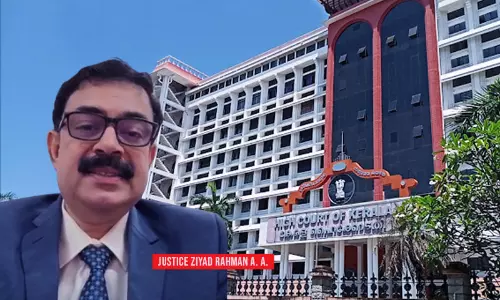
Income Tax Act | To Claim Deduction U/S 54F, Assessee Must Show Intention To Repay Borrowed Funds With Capital Gains: Kerala HC
The Kerala High Court stated that to claim the Section 54F deduction under the Income Tax Act, the assessee must satisfy the authorities that borrowed funds were used at their own risk with the intention to be repaid with capital gains. Section 54F of the Income Tax Act, 1961, allows a tax exemption on capital gains earned from selling a residential property, but only if certain rules are followed. Justice Ziyad Rahman A.A. stated that "...even in a case where, the residential...
![[Article 226] Writ Courts Cant Command Banks To Not Cancel One Time Settlement Facility Granted To Customers: Kerala High Court](http://beta.livelawbiz.com/h-upload/2025/02/03/500x300_584808-750x450570990-justice-anil-k-narendran-justice-muralee-krishna-s-kerala-hc.webp "[Article 226] Writ Courts Cant Command Banks To Not Cancel One Time Settlement Facility Granted To Customers: Kerala High Court")
[Article 226] Writ Courts Can't Command Banks To Not Cancel One Time Settlement Facility Granted To Customers: Kerala High Court
The Kerala High Court has held that a party cannot invoke the writ jurisdiction under Article 226 of the Constitution to seek a direction to a bank not to cancel the OTS (One Time Settlement) facility granted to it.The appellant had approached the Single Bench seeking a writ of mandamus against Indian Overseas Bank not to cancel the OTS facility and to consider favourably their request to extend the timeline granted in the facility. The writ petition was disposed of directing the bank to...
No Violation Of Article 14 In Denying Property Tax Exemption To Unaided Schools: Kerala High Court
The Kerala High Court stated that there is no violation of Article 14 in denying property tax exemption to unaided schools. Justice Ziyad Rahman A.A. stated that the fact that the Government owned, managed and aided schools are established by the Government at their funds in order to provide education to all classes of persons by collecting nil or meagre fees, is a crucial factor which distinguishes such establishments from an unaided school, where fees is collected from the students...
No KVAT Levy On Advertisement Hoardings Where Right To Use Has Not Been Transferred: Kerala High Court
The Kerala High Court has held that transactions involving the display of advertisements on hoardings are not taxable under the Kerala Value Added Tax Act (KVAT), where the right to use has not been transferred. Justice Ziyad Rahman A.A. agreed with the assessee that the charges collected by the assessee for displaying the advertisement included the charges for erection, printing and maintenance, etc. Thus, the responsibility to maintain the hoarding was with respect to the...
DRT Cannot Reject Consolidated Plea By Tenants Under SARFAESI Act: Kerala High Court
The Kerala High Court has held that the Debts Recovery Tribunal (DRT) cannot reject a consolidated plea by tenants under the SARFAESI Act.The petition was filed, challenging an order passed by the registrar of the DRT 1, Ernakulam. By that order, it declined to register the application preferred by the petitioners against the notice of dispossession served by the Advocate Commissioner. The application was rejected, citing the reason that a consolidated securitisation application was filed...
Writ Petition Is Maintainable Despite Remedy Under IBC, If NCLT Order Is Passed In Violation Of Natural Justice: Kerala High Court
The present writ petition was filed seeking the quashing of an order passed by the NCLT, Kochi Bench. By that impugned order, the adjudicating authority has directed the resolution professional to reject the claim filed by the home buyers, including the petitioner. The corporate debtor, who is the builder and the landowner, entered into an agreement to construct the building named Kerl Trade Centre at Marine Drive, Cochin. Sale deeds were executed by the landowners in favor of the...
KVAT Act | Input-Tax Credit Can Be Availed If Purchaser Has Genuine Invoices Even If Seller Fails To Remit Tax: Kerala High Court
The Kerala High Court, overruling its earlier decision in C.P. Rasheed v. State of Kerala, has held that input tax credit can be availed under the Kerala Value Added Tax Act, 2003 if the purchaser has genuine tax invoices even if the seller fails to remit tax.The bench opined that “the input tax credit can be legitimately availed by the purchasing dealer under the Kerala Value Added Tax Act, 2003, even in cases where the selling dealer failed to remit the tax due to the...

Property Tax Can't Be Levied Without Following Statutory Assessment Procedure U/S 233 Of Kerala Municipality Act: High Court
The Kerala High Court stated that property tax can't be levied without following statutory assessment procedure under Section 233 of Kerala Municipality Act, 1994. Section 233 of the Kerala Municipality Act, 1994, deals with the levy of property tax by the Municipality on buildings and lands within its area. This section outlines the process of assessment and collection of property tax, specifying that it should be levied in accordance with the Act and prescribed rules. Justices ...
Revisional Authority U/S 264 Of Income Tax Act Can Only Review Existing Orders, Cannot Issue Directions To Assessing Authority: Kerala HC
The Kerala High Court stated that the powers of revisional authority under Section 264 of the Income Tax Act is confined to reviewing existing orders, and the authority cannot issue directions to the assessing authority. Section 264 of the Income Tax Act, 1961 empowers the Principal Chief Commissioner, Chief Commissioner, Principal Commissioner, or Commissioner to revise certain orders. Justice Ziyad Rahman A.A. agreed with the department that powers conferred upon the revisional...

Department Serving Notice Via WhatsApp Post-COVID Is Not Valid U/S 169 CGST Act: Kerala High Court
The Kerala High Court stated that notice via WhatsApp was permitted only during COVID-19 pandemic and is not a valid mode of service under Section 169 CGST Act. Section 169 of the Central Goods and Services Tax (CGST) Act, 2017, outlines various methods for serving notices, orders, or communications under the GST law. Justices Nitin Jamdar and Basant Balaji was addressing the case where the department had served the detention and confiscation order to the assessee through...