
Madras High Court

Income Tax Act | Trust's Legitimate Tax Exemption Cannot Be Denied For Delay In Filing Form 10B: Madras High Court
The Madras High Court held that delay in filing Form 10B required under Section 44AB for the purpose of Section 12A(1)(b) of the Income Tax Act, 1961, is not a ground to deny legitimate exemption tax exemptions. Justice C. Saravanan observed that the assessee was registered as a “Trust” in the year 2017. Effectively, the assessee would have carried on operation as a “Trust” from 01.04.2017 onwards, which would fall under the Assessment Year 2018-2019. The failure is in the year...

TNGST Act | Purchase Tax Cannot Be Levied on Buyer for Seller's Tax Default: Madras High Court
The Madras High Court on Monday held that purchase tax cannot be levied under Section 7A of the Tamil Nadu General Sales Tax Act, 1959 (TNGST Act) on the purchaser merely because the seller failed to pay tax. The bench, comprising Justices S M Subramaniam and Mohammed Shaffiq, clarified the scope of Section 7A in transactions where the vendor has defaulted on tax payments "Having found that the sale to petitioner is liable to tax in the hands of the petitioner's vendor, levy of purchase tax...
Madras High Court Lets Udaipur Salon Keep 'Bounce,' Lifts Earlier Ban
The Madras High Court has recently lifted an interim injunction that had previously restrained an Udaipur-based salon from using the name “Bounce,” noting that the term is common in the beauty and haircare industry. In a ruling delivered on October 25, A Single Bench of Justice N. Senthilkumar, vacated the injunction that had been granted in favor of Spalon India Pvt. Ltd., the operator of the well-known “Bounce” salon chain in South India. As per Spalon India, it has been in the salon...
Approval From Higher Authority Mandatory For Issuing Notice U/S 148 Income Tax Act After Expiry Of 3-Year Limitation: Madras High Court
The Madras High Court has held that under the new regime, approval from a higher authority, such as the Principal Chief Commissioner of Income Tax or the Principal Director General, is mandatory to issue a notice under Section 148 of the Income Tax Act after the expiry of a three-year limitation period. Justice C. Saravanan stated that …….three years from the end of the Assessment Year 2016-2017, 2017-2018 and 2018-2019, to issue Section 148 Notice under the new regime had already...

Transactions Purely Commercial; Public Trust Doctrine Can't Defeat Limitation: Madras HC Dismisses GAIL Appeals In ₹246 Cr Dispute
In an important ruling for the natural gas sector, the Madras High Court Bench of Justices G Jayachandran and Mummineni Sudheer Kumar denied appeals by GAIL (India) Limited against five natural gas supplier companies in arbitrations aggregating to Rs. 246 crores, observing that natural gas transactions are commercial and GAIL could not invoke the public trust doctrine to escape limitation.Five companies, M/s Arkay Energy (Rameswaram) Limited, M/s Coromandel Electric Co Ltd, M/s Sahell Exports...

Petition U/S 34 A&C Act Filed With Deficit Court Fee Is Non-Est Unless Paid Within Limitation Period: Madras High Court
The Madras High Court held that filing of a petition with deficit court fee does not amount to proper presentation. If the entire court fee is not deposited within the limitation period under section 34(3) Arbitration and Conciliation Act, 1996 (Arbitration Act), the court is divested of its power to condone the delay. Justice N. Anand Venkatesh held that "filing of a petition with deficit Court fee cannot be construed as proper presentation of the petition. If such presentation of the...
Test Of Prejudice Irrelevant When Tribunal Is Constituted Without Consent Of JV Partner: Madras High Court Sets Aside Arbitral Award
The Madras High Court set aside an arbitral award passed against M/s Nilakantan & Brothers Constructions Pvt. Ltd. (“the petitioner”) on the ground that since the arbitral tribunal was constituted without obtaining the consent of a Joint Venture Partner, it lacked jurisdiction. The court further held that the appointment cannot be validated merely on the ground that no prejudice would be caused to a party. Justice N. Anand Venkatesh held that “the Tribunal did not go into this...
Principles Of Natural Justice Are Non-Negotiable In Arbitral Proceedings Even If Tribunal Is Comprised Of Lay Persons: Madras High Court
The Madras High Court, while setting aside an arbitral award, has observed that despite the arbitral Tribunal comprising elder family members, who are lay persons and not well-trained legal minds, the principles of natural justice have to be followed. If an award is passed without giving an opportunity to either of the sides to present their case, the same would violate Section 34(2)(a)(iii) of the A&C Act. The bench of Justice N. Anand Venkatesh, while hearing a challenge under ...
Customs Authorities Lack Jurisdiction To Issue Directions Under GST Law: Madras High Court
The Madras High Court recently held that Customs authorities have no jurisdiction to issue directions under the Goods and Services Tax (GST) law. The Court struck down a February 2021 public notice issued by the Chennai Customs that sought to regulate the GST treatment on auctioned cargo.A single bench of Justice N Anand Venkatesh ruled that such powers lie exclusively with authorities designated under the GST Act."It is not known as to where the 1st respondent gets the power and jurisdiction to...
Deliberate Non-Participation In Arbitral Proceedings Not Grounds To Resist Enforcement Of Award: Madras High Court
The Madras High Court bench of Justice N Anand Venkatesh has observed that when a party purposely fails to avail an opportunity duly accorded by the Arbitral Tribunal to present its case, it cannot later use its own default as a ground to resist enforcement of the resultant award. Facts The Petitioner, M/s Vittera BV (“Vittera”) filed the present petition seeking enforcement of the final award dated 30.04.2020 against the Respondent, M/s SKT Textile Mills (“SKT”) under Sections 47...
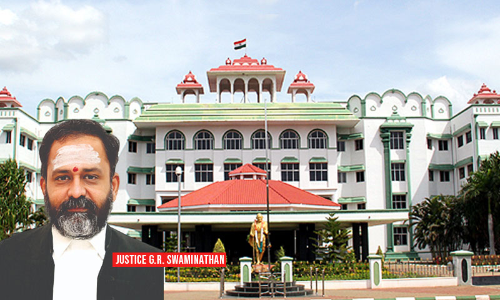
Customs Brokers Licensing Regulations | 'Offence Report Need Not Be Penal'; 90-Day Period Begins Only Upon Receipt Of Report: Madras High Court
The Madras High Court stated that the offence report under Regulation 17(1) Customs Brokers Licensing Regulations, 2018, need not necessarily have a penal connotation. Also, it stated that the 90-day limitation period begins only upon receipt of the offence report.The bench stated that, "the offence report must be received by the office of the licensing authority, and the limitation period will start running only from the date of its receipt. Even if the licensing authority can be attributed...