
Orissa High Court
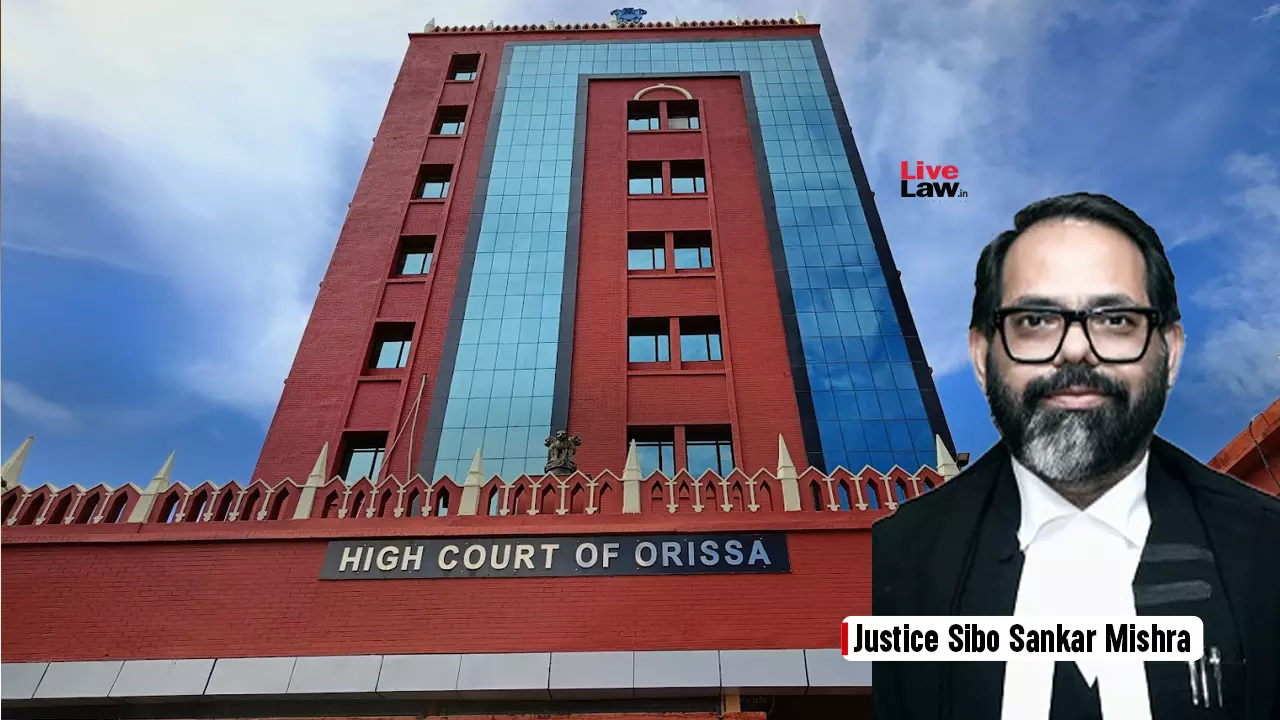
Compounding Of Offences Allowed Under IT Act, HC's Inherent Jurisdiction U/S 482 CrPC Cannot Be Invoked For Quashing: Orissa HC
The Orissa High Court has refused to entertain a petition filed for quashing the offence under Sections 276(B) of the Income Tax Act, 1961, stating that the Petitioner-accused should have sought compounding of the offence. Justice Sibo Sankar Mishra observed, “In the present regime, where the compounding of the offence is permissible, the jurisdiction of this Court under Section 482 Cr.P.C. may not be necessarily invoked by the petitioner. In that view of the matter, the petitioner...
Dispute Related To Infringement Of Copyright Is Arbitrable, Arbitrator Can Be Appointed U/S 11 Of Arbitration Act: Orissa High Court
The Orissa High Court bench of Chief Justice Chakradhari Sharan Singh has held that dispute related to infringement of copyright is arbitrable for which arbitrator can be appointed by the court under section 11 of the Arbitration Act. Brief Facts The present application has been filed under section 11(6) of the Arbitration Act, seeking appointment of an Arbitrator to resolve the dispute between the parties. The application was opposed by the other party on the ground that the...
Orissa High Court Quashes Order After Assessee Fails To Prosecute Appeal Due To Ongoing Medical Treatment
The Orissa High Court, considered that the assessee was unwell and undergoing medical treatment at the time the notices regarding his appeal were served and accordingly quashed the order demanding liability for unpaid tax. The Bench consisting of Justices Arindam Sinha and M.S. Sahoo was considering a case in which the assessee/petitioner failed to reply to the notice regarding his appeal due to health issues. In this case, the assessee/petitioner failed to attend scheduled...
MSME Council Award Can Be Challenged Only U/S 34 Of Arbitration Act, Not Under Articles 226 Or 227: Orissa High Court
The Odisha High Court bench of Chief Justice Chakradhari Sharan Singh and Justice Murahari Sri Raman has upheld that an arbitral award passed by the Micro and Small Enterprises Facilitation Council (MSEFC) could only be challenged in accordance with Section 34 of the Arbitration and Conciliation Act, 1996, as mandated by Section 19 of the MSMED Act. The court held that the Single Judge had rightly declined to entertain the challenge to the award under Article 226/227 of the Constitution,...
Entry Made In Dispatch Register Is Not Primary Evidence To Prove Service Of Notice On Assessee: Orissa High Court
The Orissa High Court has made it clear that an entry in the dispatch register maintained by the Revenue is not primary evidence to show service of notice on an assessee. In the case at hand, Petitioner-assessee was aggrieved by rejection of application made under section 154 in Income Tax Act, 1961 for rectification. Petitioner was issued a notice for scrutiny assessment under Section 143(1). It was the Petitioner's case that he was erroneously assessed in spite of being entitled...

All Claims Before Approval Of Resolution Plan Are Extinguished Once Plan Is Approved U/S 31 Of IBC: Orissa High Court
The Orissa High Court Bench of Mr. Justice D.Dash and Mr. Justice V. Narasingh held that all liabilities of the corporate debtor prior to approval of resolution plan stand extinguished once the plan is approved under section 31 of the Insolvency and Bankruptcy Code (IBC). In this case, three writ petitions were filed against demand letters issued by the state (opposite parties) demanding statutory dues. Brief Facts The State Bank of India (financial creditor) filed an application...

S. 2(h) Orissa Entry Tax Act | Tractor Trolley Not 'Motor Vehicle' & Not Amenable To Entry Tax: High Court
The Orissa High Court has held that tractor trailer/trolley is not a 'motor vehicle' as per Section 2(h) of the Orissa Entry Tax Act, 1999 ('OET Act') and therefore, not amenable to entry tax as per the said statute.Interpreting the meaning of 'motor vehicle' as per the Motor Vehicles Act, 1988 ('MV Act') as well as the OET Act, the Division Bench of Justice Arindam Sinha and Justice Mruganka Sekhar Sahoo held:“We have already seen definition given of 'motor vehicle' and 'vehicle' in section...

CPC Provisions Govern Stay Of Execution Proceedings Initiated Under Section 36(1) Of Arbitration Act: Orissa High Court
The Orissa High Court bench of Justice Sanjay Kumar Mishra has held that held that since the Arbitration Act is silent on the aspect of filing an application before the executing court to stay the operation of execution proceedings initiated under Section 36(1) of the Arbitration Act, the provisions of the CPC would be followed for this purpose. The High Court noted that the Arbitration Act provides in Section 35 that an arbitral award is final and binding, subject to the provisions of...
Limitation Period For Arbitration Starts From Date When Cause Of Action Accrued: Orissa High Court
The Orissa High Court bench of Justice D. Dash has held that the period of limitation for commencing arbitration runs from the date when the cause of arbitration accrued. This means from the date when the claimant first acquired the right to either take action or require arbitration. Therefore, the bench held that the limitation period for starting arbitration matches the period from when the cause of action would have accrued if there were no arbitration clause. The bench referred...

No Reappreciation Of Evidence Permitted Under Section 34 Of Arbitration Act, Arbitrator's Views Must Be Respected: Orissa High Court
The Orrisa High Court bench of Justice D. Dash held that in a petition under Section 34 of the Arbitration and Conciliation Act, 1996, reappreciating evidence is not allowed in order to replace the arbitrator's view with another. It held that the views expressed by the arbitrator must be considered as possible interpretations based on the factual circumstances. Section 34 deals with the application for setting aside an arbitral award. This section allows a party to challenge the...
Information Related To Outcome Of Tax Evasion Petition Sought Under RTI Act Can't Be Provided: Orissa High Court
The Orissa High Court has held that information related to the outcome of a tax evasion petition sought under the Right to Information Act cannot be provided.The bench of Justice B.R. Sarangi and Justice G. Satapathy has observed that the claim of the petitioner with regard to the supply of information sought in the application filed under the Right to Information Act is not permissible in view of the provisions contained under clause (i) of Section 8(1) of the Right to Information Act. As per...
Reassessment Order Can't Merely Be Based On Tax Evasion Report Or An Audit Report: Orissa High Court
The Orissa High Court has held that reassessment orders cannot merely be based on a tax evasion report or an audit report.The bench of Justice B.R. Sarangi and Justice G. Satapathy has observed that it is not enough if the Assessing Officer refers to the tax evasion report or an audit report; he has to independently apply his mind and record his satisfaction that there has been an escapement of tax. It is the mandatory minimum requirement of Section 43 of the OVAT Act.The petitioner or...