
Supreme Court
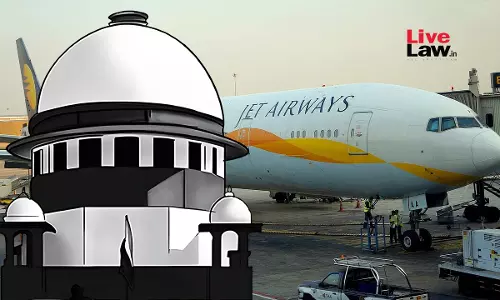
Supreme Court Orders Liquidation Of Jet Airways On Failure Of Resolution Plan
The Supreme Court invoked its extraordinary powers under Article 142 of the Constitution to order the liquidation of Jet Airways in view of the "peculiar and alarming" circumstance that the resolution plan has not been implemented for five years.The Court set aside the NCLAT Order which allowed the cash-strapped Jet Airways' ownership transfer to the Successful Resolution Applicant (SRA) without complete payment in accordance with the resolution plan. The Court directed the NCLT Mumbai...
'IBC Prevails Over SEZ Act', Supreme Court Rejects Noida SEZ's Claim
The Supreme Court dismissed the Noida Special Economic Zone's (NSEZ) plea challenging the NCLAT's decision to approve a resolution plan that granted Rs. 50 Lacs against NSEZ's admitted claim of about Rs. 6 Crore.The NCLAT reduced the claim amount, partly due to penalties related to the renewal of the sub-lease and transfer charges.The bench comprising Justices Abhay S. Oka and Augustine George Masih ruled that the Insolvency and Bankruptcy Code (IBC) prevails over the SEZ Act due to Section 238...
Inherent Powers Under Rule 11 of NCLT Rules Cannot Be Used To Circumvent Procedure To Withdraw CIRP Under S.12A IBC & R. 30A: Supreme Court
The Supreme Court Bench led by CJI DY Chandrachud comprising Justices JB Pardiwala and Manoj Misra held that 'inherent powers' cannot be used to subvert legal provisions, which exhaustively provide for a procedure. To permit the NCLAT to circumvent this detailed procedure by invoking its inherent powers under Rule 11 would run contrary to the carefully crafted procedure for withdrawal. In the Impugned Judgement, the NCLAT does not provide any reasons for deviating from this procedure...
IBC | No Compulsion To Specify Names Of Creditors In Balance Sheet, General Entry Acknowledging Debt Sufficient To Initiate CIRP : Supreme Court
Observing that there's no compulsion for the companies to specify the names of every secured/unsecured creditor in their balance sheet, the Supreme Court dismissed the plea of a corporate debtor's suspended director against the initiation of Corporate Insolvency Resolution Process (“CIRP”). In other words, the bench comprising Justices PS Narasimha and Sandeep Mehta observed that when debt entries exist in the corporate debtor's balance sheet, the debtor could not deny its liability merely on...

Supreme Court Sets Aside NCLAT Order Which Closed Insolvency Process Against Byju's Based On Settlement With BCCI
The Supreme Court today (October 23) set aside the order of the National Company Law Appellate Tribunal which closed the insolvency proceedings against ed-tech company Byju's (Think and Learn Pvt Ltd) accepting a settlement between it and the Board of Control for Cricket in India (BCCI) for about Rs 158 crores.The Court held that the NCLAT erred in allowing the withdrawal of the insolvency application by invoking its inherent powers under Rule 11 of the NCLAT Rules 2016. When there is a specific...
'Breaches Discipline Of Law Laid Down In IBC' : Supreme Court Disapproves Of HC Deferring CIRP Under Article 226
The Supreme Court recently took exception to the Telangana High Court ordering the deferring of the Corporate Insolvency Resolution Process in the exercise of powers under Article 226 of the Constitution.The Bench of Chief Justice of India DY Chandrachud , Justice J.B. Pardiwala and Justice Manoj Misra, held that the High Court was not justified in deferring the Corporate Insolvency Resolution Process (CIRP) when the main relief sought in the writ petition uto consolidate the CIRP of two...
Free Copy Of NCLT Order & Copy Of Order Obtained On Paying Cost Are 'Certified Copies' For Filing NCLAT Appeal : Supreme Court
The Supreme Court today (September 27) set aside an order of the National Company Law Appellate Tribunal (NCLAT) which refused to condone delay in filling an appeal because of the filling of a 'free copy' of the impugned order.The bench of CJI DY Chandrachud and Justice Manoj Misra held that there was no difference between a free certified copy of the order and a certified copy which is obtained after paying cost under Rule 50 of the National Company Law Tribunal Rules 2016. "Both the...
Stakeholders Consultation Committee's Advice Not Binding On Liquidator: Supreme Court
Recently, the Supreme Court clarified that the advice offered by the Stakeholders Consultation Committee (SCC) constituted in liquidation proceedings is not binding on the Liquidator. In this case, the appellant claimed that the Liquidator failed to constitute an SCC before initiating a liquidation process. However, the respondent refuted this argument stating that constituting an SCC was not a requirement at that time because an Explanation appended to Regulation 31A was inserted in the...
IBC| Timeline To Pay Balance Sale Consideration By Auction Purchaser In Liquidation Proceedings Mandatory : Supreme Court
The Supreme Court recently interpreted Rule 12 of Schedule 1 under Regulation 33 of the Insolvency and Bankruptcy Board of India (Liquidation Process) Regulations, 2016 as mandatory in character. Rule 12 relates to how assets of the Company (Corporate debtor) are to be sold by the Liquidator. Rule 12 reads: "On the close of the auction, the highest bidder shall be invited to provide balance sale consideration within ninety days of the date of such demand: Provided that payments made after...
IBC | 'Auction-Purchaser Entitled To Benefit Of COVID Limitation Extension' : Supreme Court Refuses To Cancel Sale Over Delayed Deposit
The Supreme Court recently refused to cancel an e-auction despite the Auction Purchaser making a glaring default in making a deposit of the balance sale consideration on grounds that the subject matter of the auction has been utilised and the appellant failed to approach the court on time.A bench of Justices Hima Kohli and Ahsanuddin Amanullah noted: "Much water has flown under the bridge by now. The subject land has been utilized by the Auction Purchaser to build a 200-bed Mother and Child...
IBC | CIRP Of Holding Company Cannot Include Subsidiary's Assets: Supreme Court
The Supreme Court on Monday (July 23) held that a holding company is not the owner of its subsidiary's assets and thus, subsidiary assets cannot be included in the holding company's resolution plan.A bench of Justice Abhay Oka and Justice Pankaj Mithal dismissed an appeal filed by a Successful Resolution Applicant of a Corporate Guarantor against NCLT's decision to admit Financial Creditor's application for recovery of balance amount from the Corporate Debtor. The Corporate Debtor in this case...