
Supreme Court
Tax Return Filed Without Regular Books Of Account Not Invalid, Burden To Call For Curing Of Defects On Assessing Officer: Supreme Court
While deciding the question as to whether reopening of a concluded assessment under Section 147 of the Income Tax Act (“Act”) was legally sustainable or not, the Supreme Court recently held that for the purposes of tax assessment, an assessee's obligation is limited to making a "full and true" disclosure of all "material" or primary facts, and thereafter, the burden shifts on the...
Taxpayer Entitled To Hearing On Merits If Appeals Were Dismissed By HC For Delay In Filing Paper-Book: Supreme Court
While setting aside the Rajasthan High Court orders, the Supreme Court restored the assessee's appeals by condoning the delay in filing the paper-book before High Court and observed that the assessee is entitled to have his appeals heard on merits.The Division Bench comprising of Justice P.S. Narasimha and Justice Aravind Kumar, observed that “As Appeal No. 817 of 2008 stood dismissed...
Indian Tax Authorities Favoured: Supreme Court Rules On The 'Most Favoured Nation' Controversy
In a ground-breaking judgment in the case of Assessing Officer Circle (International Taxation) 2(2)(2) New Delhi v. Nestle SA, the Supreme Court of India (“SC”) has definitively addressed the contentious issues surrounding the Most Favoured Nation (“MFN”) clause in Double Taxation Avoidance Agreements (“DTAA”). Background of the Controversy A DTAA is an agreement between two or more countries designed to prevent the double taxation of income by establishing rules for...

Double Taxation Avoidance Agreement Cannot Be Enforced Unless Notified By Centre Under Section 90 Income Tax Act : Supreme Court
The Supreme Court has held that a Double Taxation Avoidance Agreement (DTAA) cannot be given effect to by a court, authority or a tribunal unless it has been notified by the Central Government under Section 90 of the Income Tax Act.The Court held that until the Government of India issues a notification as per Section 90, the DTAA treaty is not enforceable per se in Indian courts.A...
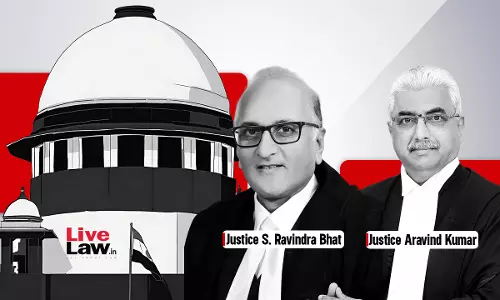
S.153C Income Tax Act | Preceding 6 Years Period As Regards 3rd Party To Be Calculated From Date When Documents Are Assigned To Concerned AO : Supreme Court
The Supreme Court has rejected the argument of the Income Tax department that Section 153C of the Income Tax Act 1961 empowers the assessing officer to seek information from a third party regarding income tax returns of the period of six years preceding the date of the search of the assessee whose premises was originally searched.A Bench comprising Justice S. Ravindra Bhat and Justice...
Income Tax Act | Completed/Unabated Assessments Cannot Be Reopened by AO If No Incriminating Material Is Found During Search: Supreme Court
The Supreme Court has reiterated that in view of the judgment of the Supreme court in Principal Commissioner of Income Tax vs. Abhisar Buildwell Pvt. Ltd.,2023 LiveLaw (SC) 346, an Assessing Officer (AO) cannot make additions to assessee’s income in respect of completed/unabated assessments if no incriminating material has been found during the course of search under Section 132 or...
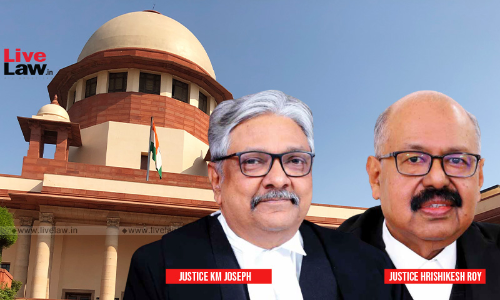
Income Tax Act - Carrier of Goods Not An ‘Owner’; Bitumen Not A ‘Valuable Article’ Under S. 69A : Supreme Court
The Supreme Court has ruled that bitumen cannot be treated as a ‘valuable article’ under Section 69A of the Income Tax Act, 1961. The bench comprising Justices K.M. Joseph and Hrishikesh Roy made the observation while dealing with an appeal filed against the decision of the Patna High Court, who had upheld the additions made by the Assessing Officer (AO) towards the bitumen lifted by...
Loss On Confiscation Of Smuggled Items By DRI Officials Cannot Be Claimed As ‘Business Loss’ Under Income Tax Act: Supreme Court
The Supreme Court bench comprising Justices M. R. Shah and M.M. Sundresh has set aside the Rajasthan High Court’s order of allowing the loss claimed by the assessee on account of confiscation of silver bars by the Customs department, as ‘business loss’ under Section 37(1) of the Income Tax Act, 1961. Justice M. R. Shah reckoned that the assessee was carrying on a legitimate...
Income Tax Act- AO Can’t Make Additions to Completed Assessments In Absence Of Incriminating Materials: Supreme Court
The Supreme Court has ruled that no additions can be made by the Assessing Officer (AO) under Section 153A of the Income Tax Act, 1961 in the absence of any incriminating material found during the course of search under Section 132 or requisition under Section 132 A, in respect of completed /unabated assessments. The bench of Justices M.R. Shah and Sudhanshu Dhulia remarked that...
Transfer Pricing | High Courts Not Precluded From Scrutinising ITAT’s Determination Of Arm’s Length Price : Supreme Court
The Supreme Court has ruled that the High Court is not precluded from considering the determination of the arm’s length price determined by the Income Tax Appellate Tribunal (ITAT), in exercise of its powers under Section 260A of the Income Tax Act, 1961.Dismissing the proposition that in every case where the Tribunal determines the arm’s length price, the same shall attain finality,...
S. 80-IB Of Income Tax Act - Assessee Not Entitled To Deduction Under On Profit Derived From DEPB And Duty Drawback Schemes: Supreme Court
The Supreme Court has ruled that the assessee is not entitled to deduction under Section 80- IB of the Income Tax Act, 1961 on the amount received / profit derived from the Duty Entitlement Pass Book Scheme (DEPB) and the Duty Drawback Schemes.The bench of Justices M.R. Shah and B.V. Nagarathna held that the profit from DEPB and the Duty Drawback claims cannot be said to be an income...