
Supreme Court
NCLT Can Order Forfeiture Of Entire Deposit If Purchaser Of Liquidation Assets Defaults In Payments : Supreme Court
The Supreme Court held that if a purchaser defaults on payment for assets acquired in liquidation under a judicially supervised sale, the entire amount already deposited may be forfeited. It further clarified that Section 74 of the Indian Contract Act, 1872 cannot be invoked to seek a refund, as no contract exists between the purchaser and the liquidator, the sale being conducted under...
Income Tax | Statutory Corporation Can Claim Deduction Under S 36(1)(viii) Only For Income Directly Derived From Long-Term Finance : Supreme Court
The Supreme Court on Wednesday (December 10) held that any income earned by a statutory corporation outside its core activity of providing long-term finance for industrial, agricultural, or infrastructure development in India cannot qualify for the 40% deduction available under Section 36(1)(viii) of the Income Tax Act, 1961 (“Act”). A bench of Justice P.S. Narasimha and Justice Atul...
S. 29A Arbitration Act | Arbitrator's Mandate Terminates On Expiry Of Time; Substituted Arbitrator Must Resume After Extension : Supreme Court
The Supreme Court on Wednesday (December 10) held that once the statutory 18-month period for delivering an arbitral award expires, the arbitrator's mandate automatically comes to an end as per Section 29A(4) of the Arbitration and Conciliation Act, 1996, when no application for extension is made. Therefore, when an extension of time is granted by the Court after the mandate of the arbitrator...
Supreme Court Flags Failure Of New Arbitration Bill In Providing Statutory Appeal Against Arbitral Tribunals' Termination Orders
The Supreme Court criticised the new Arbitration and Conciliation Bill for failing to address the ambiguity regarding the relief against an arbitral tribunal terminating the proceedings, noting that the new Bill made no effort to remedy this gap in the law."It is indeed very sad to note that even after these many years, procedural issues such as the one involved in the case at hand,...
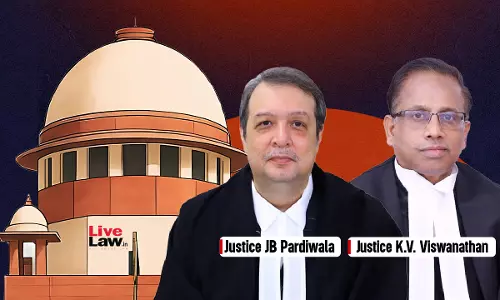
Non-Signatory Which Isn't A Veritable Party Cannot Invoke Arbitration Clause : Supreme Court
The Supreme Court on Tuesday (December 9) held that a non-signatory to an arbitration agreement cannot invoke the arbitration clause against a party with whom it shares no legal relationship and where there is no indication of any intention to bind the non-signatory to the main contract. A bench of Justice J.B. Pardiwala and Justice K.V. Viswanathan heard the matter, where the...
If Arbitral Tribunal Terminates Proceedings For Not Paying Fees, Remedy Is To Seek Recall & Then Invoke S.14(2) : Supreme Court
The Supreme Court has held that an arbitral tribunal is legally empowered to terminate proceedings under Section 38(2) of the Arbitration and Conciliation Act, 1996 when a party fails to pay its share of the arbitrator's fees.Once such a termination occurs, the remedy available to the party is to seek the recall of the order before the Tribunal itself. If the recall application is dismissed,...
Supreme Court Stays Kerala HC Order Summoning Byju's Resolution Professional In Contempt Case Over Sale Of Subsidiaries
The Supreme Court on Friday stayed the Kerala High Court's orders which had directed issuance of show-cause notices and directed Byju's Resolution Professional Shailendra Ajmera, GLAS Trust representative Sunil Thomas, and Ernst and Young Chairman Rajiv Memani to personally appear before the High Court in contempt proceedings over the sale of Byju's foreign subsidiaries Epic! Creations Inc....
Supreme Court Seeks Centre's Response On Plea Seeking GST Concession For Car Purchase By Persons With Disabilities
The Supreme Court recently issued notice on a petition filed by a person suffering visual impairment seeking that the government revive its GST Concession scheme for the purchase of cars by persons with orthopaedic disability and extend it to all Persons with Disabilities, irrespective of the nature of their disability.A bench of Justices Vikram Nath and Sandeep Mehta passed the order,...
Supreme Court Restores Property Of Corporate Debtor Attached Under PMLA To Successful Resolution Applicant
The Supreme Court recently reiterated that the objective of Section 8(8) of the Prevention of Money Laundering Act(PMLA) is to ultimately restore any attached properties to the bonafide successful resolution application(SRA) who have a legitimate interest in it.Section 8(8) allows the Special Court to direct the Central Government to restore property that has been confiscated under the Act to...
Central Excise Exemption For Cotton Fabrics Not Available If Any Interlinked Process Uses Power : Supreme Court
The Supreme Court has held that manufacturers cannot claim central excise duty exemption for processed cotton fabrics if power is used at any stage of the manufacturing chain, even when the work is carried out through separate units. The Court restored a duty and penalty demand that had been set aside by the Customs, Excise and Service Tax Appellate Tribunal (CESTAT).To claim excise...
Arbitration | No Review Or Appeal Lies Against Order Appointing Arbitrator : Supreme Court
The Supreme Court observed that a review or appeal from an order of appointment of an arbitrator is impermissible.“Once an arbitrator is appointed, the arbitral process must proceed unhindered. There is no statutory provision for review or appeal from an order under Section 11, which reflects a conscious legislative choice.”, the Court held, while setting aside the Patna High Court's...