Supreme Court
TOLA Extends Income Tax Reasssment Timelimit; Notices Can Be Issued After 2021 Under Old Regime : Supreme Court
The Supreme Court on Thursday (October 3) set aside the judgments of the High Courts which held that the Taxation and Other Laws (Relaxation and Amendment of Certain Provisions Act) (TOLA) 2021 will not extend the time limit for issuing notices for re-assessment under the Income Tax Act.A bench comprising Chief Justice of India DY Chandrachud, Justice JB Pardiwala and Manoj Misra delivered...
'Technological Impediment Can't Be A Reason To Harass Assessee' : Supreme Court Asks Income Tax Dept, CBDT To Resolve Software Issues
Technological impediment cannot be a reason to harass an assessee, said the Supreme Court while asking the Income Tax Department to upgrade its software to ensure that mistakes do not occur in the future.The Court directed that the Central Board for Direct Taxes should also take necessary steps for rectifying the software.A bench comprising Justices PS Narasimha and Sandeep Mehta was hearing...
Income Tax Act | Supreme Court Refuses To Give Retrospective Application To 2022 Amendment To S.80DD Regarding 'Jeevan Adhar' Policies
In a recent case, the Supreme Court refused to give the retrospective operation to the amended Section 80DD of the Income Tax Act, 1961 (“IT Act”) which provided an option to the subscriber the Jeevan Adhar Policy (“Policy”) upon attaining the age of 60 years to discontinue the deposit made under the policy and make use of the money accumulated for the benefit of the disabled person...
Customs Act | Importer's Subsequent Import Bill Be Discarded If Undervalued To Previously Imported Identical Or Similar Goods: Supreme Court
Recently, the Supreme Court held that under the Customs Act, the Importer's Bill of Entry of subsequent imported goods can be discarded if the subsequent imported goods are undervalued to the previously imported identical or similar goods. Affirming the findings of the Central Customs, Excise & Service Tax Appellate Tribunal (“CESTAT”), the Bench comprising Justices Abhay S. Oka...
TDS Under S.194-H Income Tax Act Won't Apply To Business Transactions Where Assessee Is Not Responsible For Paying Income : Supreme Court
In a significant development, the Supreme Court recently held that under Section 194-H of the Income Tax Act, 1961, cellular mobile service providers are not liable to deduct tax at source on income/profit component in payments received by their franchisees/distributors from third parties/customers. “…we hold that the assessees would not be under a legal obligation to deduct tax...
Reopening Of Income Tax Assessments : Supreme Court Refuses To Interfere With Delhi High Court's Guidelines To Tax Dept
The Supreme Court has refused to interfere with a 2017 Delhi High Court judgment which issued a set of guidelines to the Income Tax Department regarding the reopening of assessments.A bench comprising Justice PS Narasimha and Justice Aravind Kumar dismissed a Special Leave Petition filed by the Income Tax Department in 2018 against the 2017 High Court verdict.The Delhi High Court bench of...
Tax Return Filed Without Regular Books Of Account Not Invalid, Burden To Call For Curing Of Defects On Assessing Officer: Supreme Court
While deciding the question as to whether reopening of a concluded assessment under Section 147 of the Income Tax Act (“Act”) was legally sustainable or not, the Supreme Court recently held that for the purposes of tax assessment, an assessee's obligation is limited to making a "full and true" disclosure of all "material" or primary facts, and thereafter, the burden shifts on the...
Taxpayer Entitled To Hearing On Merits If Appeals Were Dismissed By HC For Delay In Filing Paper-Book: Supreme Court
While setting aside the Rajasthan High Court orders, the Supreme Court restored the assessee's appeals by condoning the delay in filing the paper-book before High Court and observed that the assessee is entitled to have his appeals heard on merits.The Division Bench comprising of Justice P.S. Narasimha and Justice Aravind Kumar, observed that “As Appeal No. 817 of 2008 stood dismissed...
Indian Tax Authorities Favoured: Supreme Court Rules On The 'Most Favoured Nation' Controversy
In a ground-breaking judgment in the case of Assessing Officer Circle (International Taxation) 2(2)(2) New Delhi v. Nestle SA, the Supreme Court of India (“SC”) has definitively addressed the contentious issues surrounding the Most Favoured Nation (“MFN”) clause in Double Taxation Avoidance Agreements (“DTAA”). Background of the Controversy A DTAA is an agreement between two or more countries designed to prevent the double taxation of income by establishing rules for...
Double Taxation Avoidance Agreement Cannot Be Enforced Unless Notified By Centre Under Section 90 Income Tax Act : Supreme Court
The Supreme Court has held that a Double Taxation Avoidance Agreement (DTAA) cannot be given effect to by a court, authority or a tribunal unless it has been notified by the Central Government under Section 90 of the Income Tax Act.The Court held that until the Government of India issues a notification as per Section 90, the DTAA treaty is not enforceable per se in Indian courts.A...
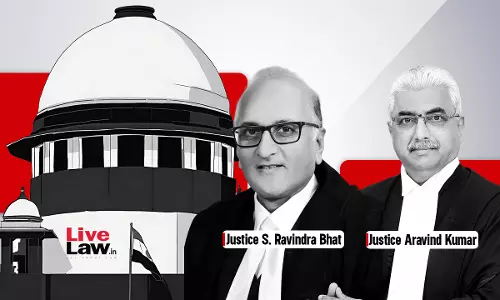
S.153C Income Tax Act | Preceding 6 Years Period As Regards 3rd Party To Be Calculated From Date When Documents Are Assigned To Concerned AO : Supreme Court
The Supreme Court has rejected the argument of the Income Tax department that Section 153C of the Income Tax Act 1961 empowers the assessing officer to seek information from a third party regarding income tax returns of the period of six years preceding the date of the search of the assessee whose premises was originally searched.A Bench comprising Justice S. Ravindra Bhat and Justice...