
Tax
Carbonated Fruit Drinks Qualify As Fruit Beverages, Taxable At 12% GST: Gauhati High Court
The Gauhati High Court stated that carbonated fruit drinks qualify as fruit beverages and are taxable at 12% GST. The Bench of Justice Soumitra Saikia opined that “where the subject product contains soluble solids and fruit content as per the report of the State Food Laboratory, it cannot be said to be akin to water, mineral water or aerated water. Mere presence of carbon dioxide...

'Cannot Be Forced To Repeatedly Approach Court': Delhi HC Orders Release Of Iran National's Jewellery Confiscated By Customs Almost 3 Yrs Ago
The Delhi High Court ordered the Customs Department to release the silver-coated gold chains of an Iranian national, which were confiscated on his arrival in India almost three years ago.A division bench of Justices Prathiba M. Singh and Rajneesh Kumar Gupta noted that the prescribed period of six months for issuance of a Show Cause Notice had already elapsed.Further, no personal hearing...

Contingent Liability vs Laid Out Expense: Delhi HC Allows Vodafone To Claim ₹5.1 Crore Depreciation Over Estimated Costs To Restore Mobile Tower Sites
The Delhi High Court has allowed Vodafone Mobile, engaged in providing telecommunication services, to claim depreciation of ₹5.10 crores in respect of fixed assets over provisioned expenditure to discharge its contractual obligation of restoring mobile tower sites to their original condition at the end of the lease period.Though Asset reconstruction Cost (ARC) was laid out by Vodafone,...
Subsequent Notice U/S 28(4) Customs Act Cannot Be 'Supplementary' To Prior Notice U/S 28(1), Both Provisions Operate In Separate Fields: Delhi HC
The Delhi High Court has held that notices under Section 28(1) and Section 28(4) of the Customs Act 1962 operate in different scenarios and even by an exaggerated stretch, cannot possibly be said to be interchangeably issued.Section 28 relates to recovery of duties not levied or not paid or short-levied or short-paid or erroneously refunded. It provides for two separate types of notices:...
FOB Value Of Goods Can't Be Modified By Anyone Including Any Customs Officer: CESTAT
The New Delhi Bench of Customs, Excise, and Service Tax Appellate Tribunal (CESTAT) has stated that no stranger to the contract, including any Customs officer has any right to interfere with the Free on Board (FOB) value of the goods. The Bench of Justice Dilip Gupta (President) and P.V. Subba Rao (Technical Member) has stated that “there is a privity of contract between the buyer...
S.28(4) Customs Act | Genuine Disagreement With Department Regarding Classification Of Goods Not 'Suppression Of Facts' By Trader: Delhi HC
The Delhi High Court has held that merely because there is disagreement between the Customs department and a trader regarding the classification of the latter's goods for the purpose of levying duty, it does not mean that the trader has indulged in 'suppression of facts' from the Department.The expression is relevant in terms of Section 28(4) of the Customs Act, 1962, which provides for...
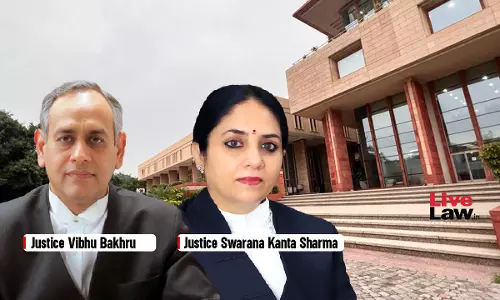
Income Tax Rules | Centre's Power To Relax Conditions Under Rule 9C Exceptional & Discretionary, Not Ordinarily Subject To Judicial Review: Delhi HC
The Delhi High Court has made it clear that the power of the Central government to relax conditions prescribed under Rule 9C of the Income Tax Rules 1962, read with Section 72A of the Income Tax Act, 1962, is exceptional, discretionary and cannot ordinarily be subject to judicial review.In terms of Section 72A of the Act, the accumulated losses and unabsorbed depreciation of the...
Customs Broker Not Responsible If Client Moves To New Premises After Verification Of Address Is Complete: CESTAT
The New Delhi Bench of Customs, Excise, and Service Tax Appellate Tribunal (CESTAT) has stated that customs broker not responsible if client moves to new premises once verification of address is complete. “The responsibility of the Customs Broker under Regulation 10(n) does not include keeping a continuous surveillance on the client to ensure that he continues to operate from...
S.36 Income Tax Act | Deduction For Bad Debt Allowed Only If Assessee Lends In Ordinary Course Of Banking/Money Lending Business: Delhi HC
The Delhi High Court has made it clear that allowance in respect of bad debts as an expense under Section 36 of the Income Tax Act, 1961, is permissible only if:(a) the debt was taken into account for computing the income of the assessee in the previous year in which the amount is written off or prior previous years; or (b) represents money lent in the ordinary course of business of banking...
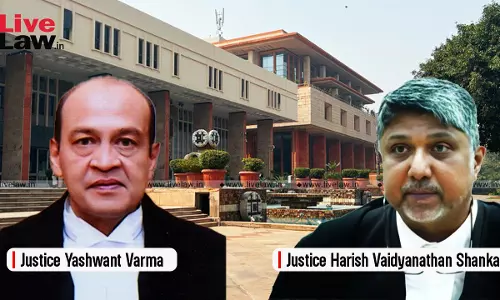
S.29 CGST Act | SCN Must Reflect Both Reasons And Intent Of Retrospective Cancellation Of Registration: Delhi High Court
The Delhi High Court has made it clear that an order cancelling GST registration of a trader with retrospective effect will not sustain unless the show cause notice preceding such decision reflects both the reasons and the authority's intent for retrospective cancellation.A division bench of Justices Yashwant Varma and Harish Vaidyanathan Shankar observed, “in the absence of reasons having...
Income Tax Act | Principal Commissioner Has Authority To Cancel Registration Of Assessee Without Waiting For Decision From Assessing Authority: Kerala HC
The Kerala High Court stated that principal commissioner has authority to cancel registration of assessee without waiting for decision from assessing authority. The Division Bench of Justices A.K. Jayasankaran Nambiar and Easwaran S. observed that “the provisions of Section 12AA independently empower the Principal Commissioner to consider whether or not the circumstances mentioned...
Income Tax | Whether There Was Proper Notice Or Not Is Disputed Question Of Fact, Can't Be Challenged Under Article 226: Kerala High Court
The Kerala High Court stated that the issue as to whether there was a proper notice or not is a disputed question of fact and cannot be challenged under Article 226 of the Constitution of India. “…….As rightly observed by the learned Single Judge, the question as to whether there was a proper notice or not is certainly a disputed question of fact, which cannot be gone into in...