
High Court

Delhi High Court Reprimands GST Dept For Raiding Lawyer's Office, Seizing Computer Over Client's Tax Case
The Delhi High Court has pulled up the GST Department for harassing a tax lawyer, by raiding his offices and seizing his files and electronic gadgets, in connection with alleged GST evasion by one of his clients.A division bench of Justices Prathiba M. Singh and Shail Jain observed that unless the Department has some material to indicate the lawyer's involvement in alleged tax evasion, it...
![[CGST Act] Penalty Is An Additional Tax, Cannot Be Levied Under State Act Without Charging Provision: J&K&L High Court](https://www.livelaw.in/h-upload/2025/06/10/500x300_604075-sanjeev-kumar-sanjay-parihar.webp "[CGST Act] Penalty Is An Additional Tax, Cannot Be Levied Under State Act Without Charging Provision: J&K&L High Court")
[CGST Act] Penalty Is An 'Additional Tax', Cannot Be Levied Under State Act Without 'Charging Provision': J&K&L High Court
The Jammu & Kashmir and Ladakh High Court has ruled that the penalty under the Central Sales Tax Act cannot be imposed by invoking provisions of the State Act in the absence of an express charging section.The Court held that the Central Act is a “self-contained code” and provides its own framework for imposition of penalties, which cannot be supplemented by state laws.A bench headed...

Arbitral Award Cannot Be Challenged Through Civil Suit: Delhi High Court
The Delhi High Court bench of Justice Jasmeet Singh has held that an arbitral award cannot be challenged through a civil suit, as such a course is clearly barred under Section 5 read with Section 34 of the Arbitration and Conciliation Act, 1996 (Arbitration Act). Such a plaint deserves to be rejected under Order VII Rule 11(d) of the Civil Procedure Code, 1908 (CPC), on the ground that it...
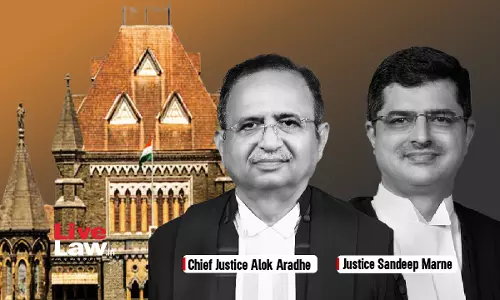
Income Tax | Sale Proceeds Of One House Used For Purchasing Multiple Residential Houses Qualifies For Exemption U/S 54(1): Bombay High Court
The Bombay High Court held that sale proceeds of one residential house, used for purchase of multiple residential houses, would qualify for exemption under Section 54(1) of the Income Tax Act. The issue before the bench was whether Section 54(1) of the Income Tax Act allows the Assessee to set off the purchase cost of more than one residential units against the capital gains earned...

DRT Cannot Reject Consolidated Plea By Tenants Under SARFAESI Act: Kerala High Court
The Kerala High Court has held that the Debts Recovery Tribunal (DRT) cannot reject a consolidated plea by tenants under the SARFAESI Act.The petition was filed, challenging an order passed by the registrar of the DRT 1, Ernakulam. By that order, it declined to register the application preferred by the petitioners against the notice of dispossession served by the Advocate Commissioner....
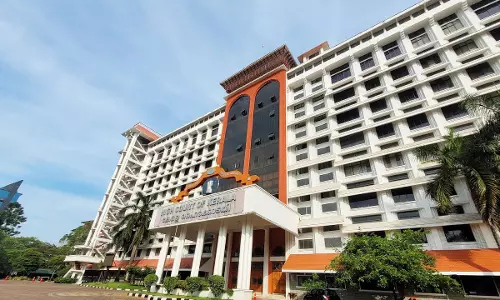
Writ Petition Is Maintainable Despite Remedy Under IBC, If NCLT Order Is Passed In Violation Of Natural Justice: Kerala High Court
The present writ petition was filed seeking the quashing of an order passed by the NCLT, Kochi Bench. By that impugned order, the adjudicating authority has directed the resolution professional to reject the claim filed by the home buyers, including the petitioner. The corporate debtor, who is the builder and the landowner, entered into an agreement to construct the building named...

Burden To Prove That Best Assessment By Income Tax Authorities Is Perverse Is On Assesee: Allahabad High Court
The Allahabad High Court has held that the burden to prove that the findings of best assessment done by the authorities is perverse is on the assesee. The bench of Justice Shekhar B. Saraf and Justice Praveen Kumar Giri held that “when a best assessment is done, it is for the assessee to bring on record the facts that may reveal that the findings are perverse in...

Scheme Of Compromise Sanctioned By Court Under Companies Act Cannot Be Frustrated By Invoking Provisions Of SARFAESI Act: Calcutta HC
The Calcutta High Court has ruled that a scheme of arrangement/compromise sanctioned under section 391 of the Companies Act, 1956, cannot be unilaterally frustrated by a secured creditor by invoking the provisions of the SARFAESI Act, 2002. The application was filed, praying for the execution of an order sanctioning a scheme of arrangement/ compromise under section 391(2) of...
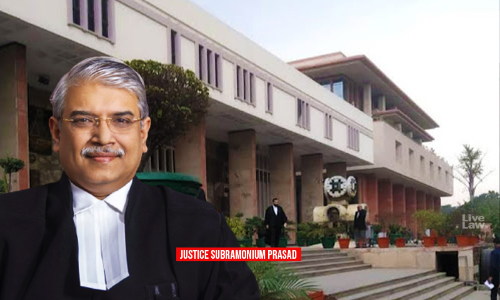
Mere Pendency Of Formal Signature By One Party Doesn't Preclude Parties From Being Referred To Arbitration: Delhi HC Allows Vedanta's Plea
The Delhi High Court bench of Justice Subramonium Prasad has held that the mere pendency of a formal signature by one party, when the other party has signed the agreement after reading and understanding its terms, including the arbitration clause, does not prevent the parties from being referred to arbitration. The Petitioner has filed this petition under section 11(6) of the...
Proceedings Can Be Remitted Back To Same Arbitrator U/S 33 & 34(4) Of A&C Act Only Before Passing Of Award: Bombay High Court
The Bombay High Court Division Bench, comprising Chief Justice Alok Aradhe and Justice Sandeep V. Marne, observed that a Section 34 Court can only remit back to the same Arbitration following the procedure for remand u/s 33 and 34(4). The act of the Appellant not issuing a notice u/s 21 of the A&C Act to the Respondent, and approaching the same Arbitration, who initiates...
Venue Is Construed As Seat In Absence Of Contrary Indicia, If Arbitration Agreement Only Mentions 'Venue': Allahabad HC
The Allahabad High Court has held that when only one place is mentioned in the arbitration agreement and is termed as “venue”, the same is to be treated as the “seat” also, unless something contrary is mentioned in the agreement.“If the arbitration agreement mentions only one place and even if it is termed as the 'venue', then unless there is a contrary indicia the 'venue' is...
KVAT Act | Input-Tax Credit Can Be Availed If Purchaser Has Genuine Invoices Even If Seller Fails To Remit Tax: Kerala High Court
The Kerala High Court, overruling its earlier decision in C.P. Rasheed v. State of Kerala, has held that input tax credit can be availed under the Kerala Value Added Tax Act, 2003 if the purchaser has genuine tax invoices even if the seller fails to remit tax.The bench opined that “the input tax credit can be legitimately availed by the purchasing dealer under the Kerala Value Added...